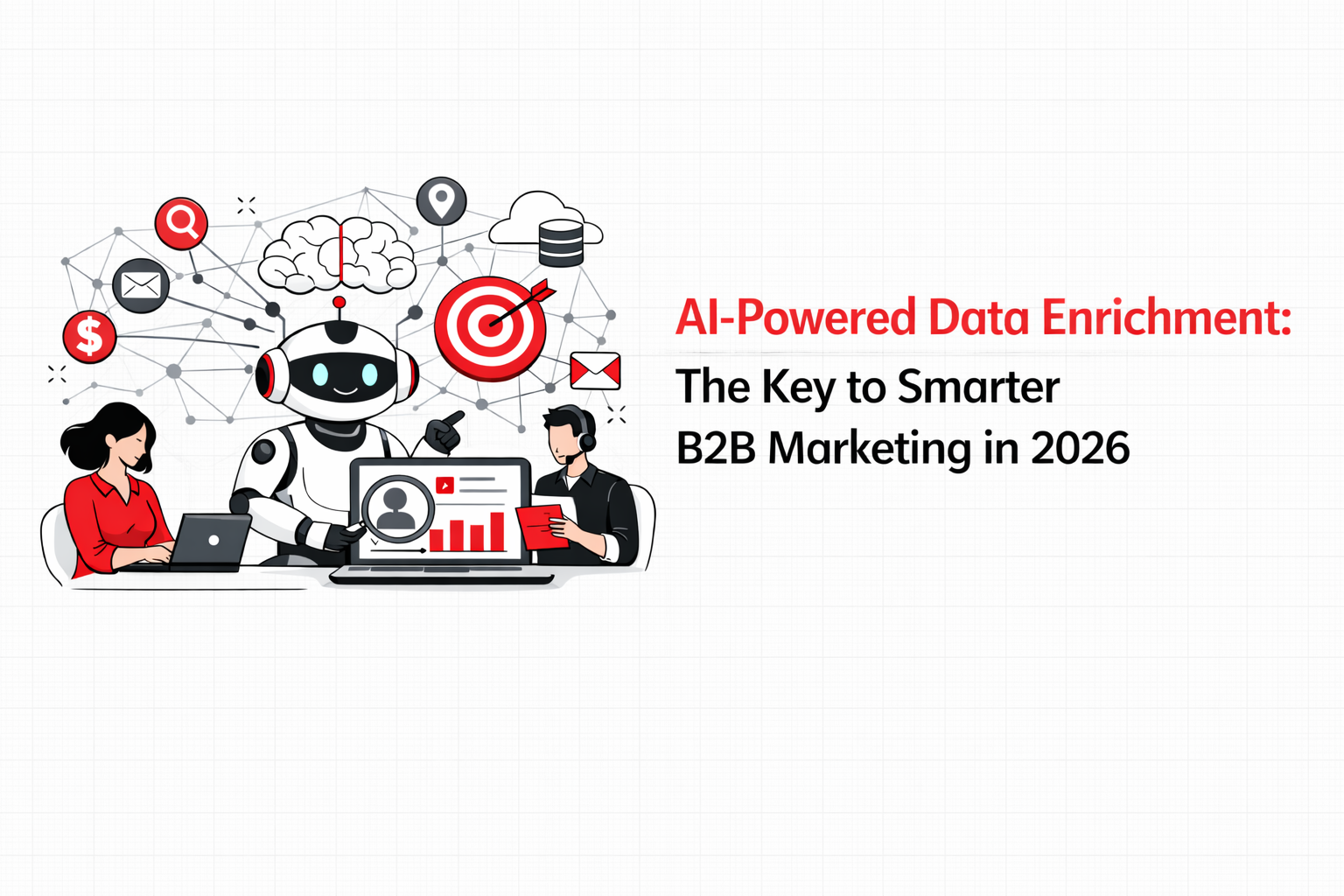
Discover how AI-powered data enrichment enhances B2B marketing strategies, enabling smarter lead generation and account-based marketing for better results.
Introduction to AI-Powered Data Enrichment in B2B Marketing
B2B databases experience an annual decay rate of approximately 30% due to changing roles, strategic shifts, and outdated firmographic details, fundamentally undermining B2B marketing initiatives. AI-powered data enrichment offers a solution by converting static contact lists into dynamic intelligence assets that evolve in real-time, leading to smarter B2B marketing strategies.
Data enrichment refers to the process of enhancing existing records with additional attributes, such as job titles, company revenue, and technology stacks, to craft comprehensive profiles. AI-driven enrichment continuously leverages machine learning algorithms to validate, standardize, and enhance data across multiple touchpoints. A recent analysis of B2B marketing trends reveals that 67% of marketing leaders now view data quality as their top operational challenge. However, organizations implementing AI enrichment capabilities report 40% higher campaign engagement rates compared to those using static databases.
Modern enrichment platforms integrate behavioral signals, intent data, and predictive scoring into unified customer profiles. This integration enables sophisticated account-based marketing AI strategies, adapting targeting decisions based on real-time engagement patterns. Advanced data intelligence capabilities offer marketing teams unprecedented visibility into prospect readiness and opportunity timing.
The shift represents more than technological advancement, it's a fundamental rethinking of how B2B organizations build and maintain their most valuable asset: customer intelligence. Understanding this foundation is key to exploring AI's transformative impact on customer segmentation.
The Role of AI in Enhancing Customer Segmentation
AI transforms traditional customer segmentation by analyzing hundreds of behavioral, contextual, and intent signals simultaneously, creating segments that reflect actual buying readiness rather than superficial demographics. Customer segmentation refers to the categorization of prospects or customers based on shared characteristics for targeted marketing strategies.
In B2B marketing, AI-powered segmentation uses machine learning algorithms to identify patterns that human analysts might overlook. A recent analysis shows that 70% of B2B marketers consider AI crucial for personalization at scale, with segmentation as the foundation for these personalized experiences. The technology processes engagement data, website behavior, content consumption, and email interactions, alongside external signals like funding events, hiring patterns, and technology adoption to create dynamic segments that evolve in real-time. Predictive segmentation doesn't just categorize existing customers but forecasts which prospects will convert based on behavioral similarities to past successful deals. This allows marketing teams to prioritize understanding specific market segments with precision previously unattainable.
AI-driven platforms adjust segments continuously as new data emerges, ensuring messaging stays aligned with prospect needs throughout the buying journey. This adaptive approach becomes increasingly critical as buying behaviors continue to fragment across digital channels.
Emerging Trends in AI-Powered Data Enrichment for Smarter B2B Marketing in 2026
Real-Time Intent Signal Integration has emerged as a critical capability, enabling sales teams to identify prospects actively researching solutions and engage at the right moment. Predictive Lifecycle Analytics represents another significant advancement, allowing marketing teams to tailor campaigns to specific lifecycle moments rather than static firmographic segments.
Privacy-Compliant Enrichment is now essential. As data regulations tighten globally, AI data enrichment platforms emphasize consent management and synthetic data generation. Organizations leverage AI to maintain data quality while respecting privacy preferences, directly impacting deliverability and brand reputation.
These capabilities position data enrichment as a strategic imperative, fundamentally changing how B2B organizations approach market intelligence and revenue growth.
Measuring the ROI of AI-Powered Data Enrichment
Quantifying the return on investment for data enrichment initiatives requires examining genuine business impact. AI-powered data enrichment enables marketers to track how enhanced data directly influences revenue outcomes.
Conversion rate improvements across the funnel are the most meaningful ROI measurements. Organizations using AI-driven enrichment typically see 25-35% increases in lead-to-opportunity conversion rates. Pipeline velocity acceleration represents another critical ROI indicator, with deal cycles compressing by an average of 15-20%.
Cost-per-acquisition metrics provide additional clarity. AI data enrichment reduces wasted outreach by identifying prospects most likely to convert, typically lowering CAC by 18-28% compared to traditional segmentation approaches.
Comprehensive ROI tracking demands integration between enrichment platforms and CRM systems to attribute revenue outcomes accurately.
Overcoming Data Privacy Challenges with AI
Regulatory frameworks like GDPR and CCPA reshape the data landscape. The challenge is enriching customer data responsibly while meeting privacy requirements. Modern AI systems strengthen privacy compliance through techniques like differential privacy, federated learning, and allowing enrichment without exposing individual records. Consent management is streamlined through AI automation, tracking individual preferences and flagging non-compliant enrichment attempts. AI-powered systems audit data sources in real-time, ensuring compliance with regulations and organizational policies.
Transparent data governance frameworks and AI-driven monitoring systems evaluate compliance status and automatically purge data when consent expires or regulations change.
Potential Risks and Challenges of Implementing AI-Powered Data Enrichment
While AI data enrichment offers transformative capabilities, several challenges must be navigated to realize its full potential in B2B marketing.
Data Quality and Accuracy Concerns
The effectiveness of AI enrichment relies on the quality of underlying data sources. Inaccuracies can propagate throughout the marketing ecosystem, leading to misaligned campaigns. Rigorous validation protocols and continuous monitoring of accuracy metrics are essential.
Connecting AI enrichment platforms with existing marketing technology stacks presents substantial technical hurdles. Legacy systems often lack the APIs or data formats necessary for seamless integration, requiring specialized expertise.
Algorithm Bias and Transparency
AI models can perpetuate biases present in training data, potentially excluding valuable market segments. Establishing explainability standards and conducting regular algorithmic audits helps mitigate this risk while maintaining compliance.
AI-powered data enrichment catalyzes transformative change in B2B marketing. Organizations embracing intelligent systems gain advantages in precision targeting, operational efficiency, and customer understanding.
AI data enrichment delivers measurable business impact. Research shows that 77% of companies using AI sales technologies experience better lead conversion, while marketing teams see productivity gains of up to 40%.
Implementation requires strategic planning, with appropriate data sources, governance frameworks, and data quality standards. Organizations must balance automation with human oversight, especially when using AI SEO tools and predictive analytics.
B2B marketers implementing AI data enrichment now position themselves to capture market share, while those who delay risk falling behind competitors leveraging superior data intelligence for improved email engagement and conversion outcomes.
The landscape of AI-powered Lead enrichment continues to evolve rapidly, supported by comprehensive research from industry analysts, technology providers, and marketing practitioners. This article synthesizes insights from multiple authoritative sources to provide B2B marketers with evidence-based guidance for implementing AI-driven data strategies.
Primary Research Sources
The State of B2B Marketing: Trends and Insights In 2026 provides comprehensive analysis of marketing technology adoption patterns and ROI benchmarks across enterprise organizations.
75 statistics about AI in B2B sales and marketing offers data-driven insights into AI implementation metrics, including adoption rates, efficiency gains, and revenue impact across various B2B sectors. The Top Three AI Trends in B2B Marketing for 2026 explores emerging AI capabilities specifically relevant to marketing automation and customer engagement strategies.
How AI and Intent Data Are Transforming B2B Sales in 2026 examines the intersection of artificial intelligence and buyer intent signals, with practical applications for sales enablement.
For organizations ready to implement these strategies, unified data enrichment platforms provide the infrastructure necessary to transform raw prospect information into actionable marketing intelligence that drives measurable business outcomes.