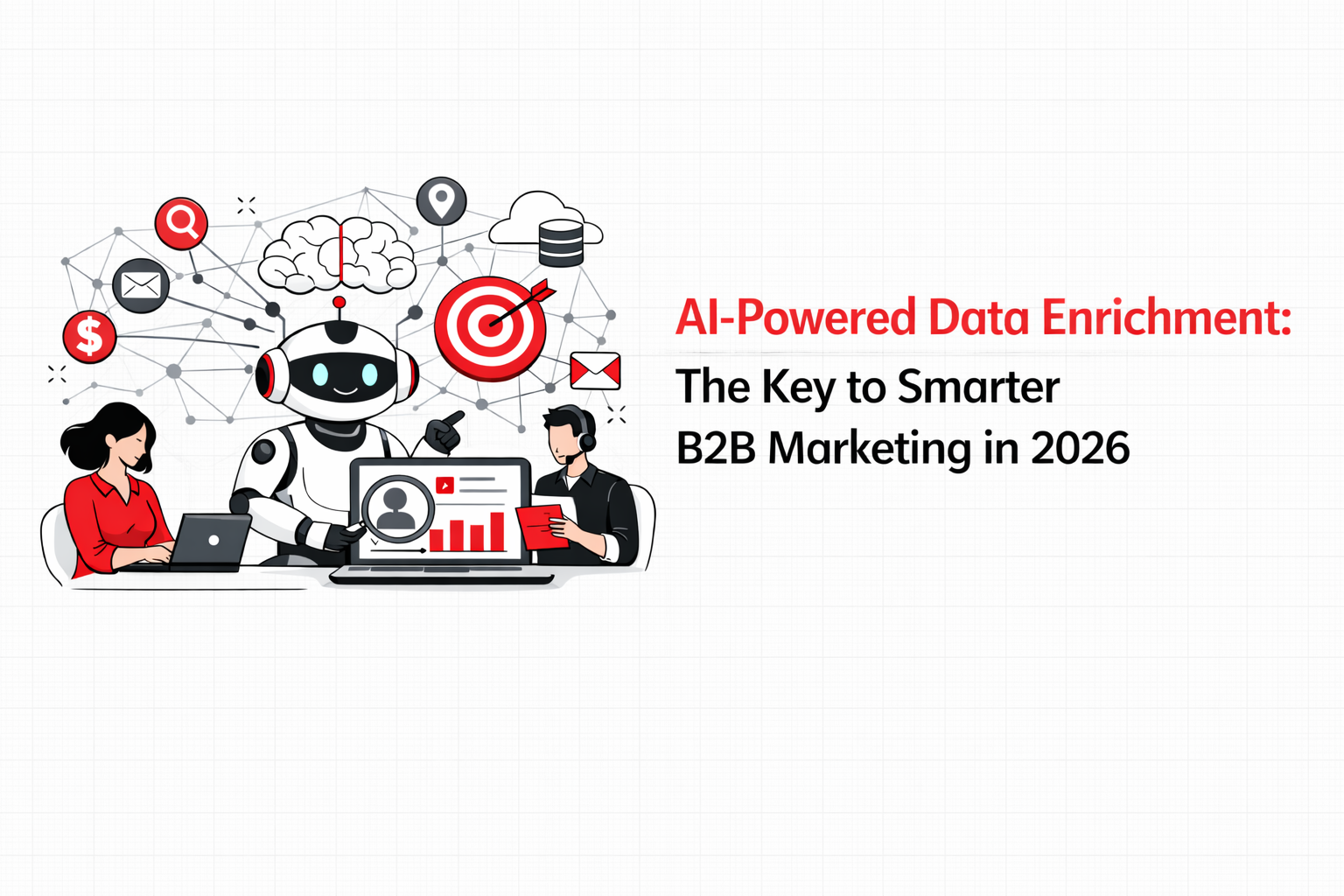
Discover how AI-powered B2B data transforms sales and marketing. Explore data enrichment, lead scoring, and predictive analytics for better decision-making.
In today’s fast-moving digital economy, data is no longer just a support function, it drives every revenue decision.
Yet, not all data is created equal, and outdated information can quietly impact performance.
This is where AI-powered B2B data is redefining how businesses identify, understand, and engage prospects.In this guide, we’ll explore how modern teams are using AI to turn data into a competitive advantage.
The Problem: Outdated B2B Data Challenges
Many B2B organizations face significant challenges with outreach campaigns due to outdated and inaccurate contact data. Despite efforts to create effective messaging and precise targeting, issues arise when a large percentage of emails bounce or reach individuals who are no longer in relevant roles.
This problem, stemming from the rapid decay of traditional B2B databases, results in wasted marketing resources, lost sales opportunities, and decreased team morale. The need for intelligent, verified B2B data is critical; modern teams require AI-powered systems that continuously update and enrich information, providing predictive insights into buyer behavior. Transitioning from static databases to dynamic data solutions can significantly enhance marketing effectiveness and sales conversion rates.
Why AI-Powered Data Matters
The gap between traditional data management and AI in B2B sales isn't just technical, it's transformative. While conventional databases require manual updates and human interpretation, AI-powered systems continuously learn, adapt, and deliver insights that would take entire teams months to uncover manually.
Consider the typical B2B sales cycle. Your team identifies prospects, researches their business landscape, determines buying signals, and times their outreach perfectly. Without AI, this process relies heavily on gut instinct and static data snapshots. Research from McKinsey shows that companies leveraging AI for sales and marketing see revenue increases of 10-15% while reducing costs by up to 20%.
AI changes the fundamentals of how B2B teams operate
Predictive accuracy : AI analyzes thousands of data points to identify which prospects are actually ready to buy, not just demographically qualified
Real-time intelligence : Contact information updates automatically as people change roles, companies merge, or new decision-makers emerge
Behavioral insights : Machine learning detects patterns in buyer behavior that humans simply can't spot at scale
Personalization at scale : AI enables customized outreach to thousands of prospects simultaneously
The impact extends beyond efficiency. B2B marketers report that AI-driven data enrichment often delivers more qualified leads and shorter sales cycles, critical advantages in competitive markets where timing often determines who wins the deal.
For UK-based revenue teams navigating increasingly complex buyer journeys, AI and automation are transforming how data quality directly impacts pipeline velocity and win rates.
How AI Impacts B2B Sales and Marketing
AI in B2B marketing isn't just accelerating existing processes, it's fundamentally restructuring how teams identify prospects, engage decision-makers, and convert opportunities. The shift affects every touchpoint in the revenue cycle, from initial outreach through post-sale expansion.
In practice, the impact manifests across three critical areas: predictive targeting, personalized engagement, and operational efficiency . Teams using AI-powered systems can analyze thousands of behavioral signals to identify which prospects show genuine buying intent. According to AI's Role in B2B Sales and Marketing, AI enables sales professionals to predict customer needs with unprecedented accuracy, transforming cold outreach into warm, contextually relevant conversations.
What typically happens is that marketing teams experience a compression of their qualification timeline. Where manual processes once required weeks of research and scoring, AI systems now evaluate firmographic data, technographic signals, and engagement patterns in real time. This allows AI-driven insights to surface high-probability accounts before competitors even identify them.
The efficiency gains are substantial. A common pattern is that sales development representatives spend 30-40% less time on manual research and data entry, redirecting those hours toward strategic conversations. However, the greatest impact isn't speed, it's precision. AI eliminates the guesswork in account selection, messaging timing, and channel preference, ensuring every resource investment targets validated opportunities rather than educated guesses.
Example Scenarios: AI in Action
To understand how B2B data enrichment transforms daily operations, consider these practical applications that sales and marketing teams are implementing today.
Scenario 1: Lead Prioritization That Actually Works
A SaaS sales team receives 200 inbound leads weekly. Rather than manually scoring each one, AI analyzes behavioral signals, website visits, content downloads, job title changes, against historical conversion data. The system automatically flags the 15% showing genuine buying intent, allowing reps to focus where revenue potential is highest. According to SmartDev's analysis of AI use cases, this approach can reduce lead qualification time by up to 70%.
Scenario 2: Dynamic Account Intelligence
Marketing teams targeting enterprise accounts can leverage AI-powered buyer intent signals to monitor real-time changes. When a target company expands operations or shifts leadership, AI systems detect these signals and trigger enrichment workflows, updating firmographic data, identifying new stakeholders, and alerting sales teams within hours rather than weeks.
Scenario 3: Personalization at Scale
A UK manufacturing firm selling to multiple verticals uses AI to segment prospects by industry-specific pain points. The system analyzes company data, recent news, and competitive movements to generate tailored email sequences. What typically required dedicated research for each account now happens automatically, maintaining personalization across thousands of contacts.
These aren't experimental pilot programs, they're standard practice for teams that recognize how data management has evolved beyond manual processes. The common thread? AI doesn't replace human judgment; it enhances what experienced professionals already know matters.
Trade-offs and Limitations
While AI-powered data platforms deliver significant advantages, they aren't without constraints. Understanding these trade-offs helps teams set realistic expectations and build more effective implementation strategies.
Data quality remains paramount. AI systems amplify what they're fed, garbage in, garbage out still applies. If your initial data contains significant errors or outdated information, even sophisticated algorithms will produce questionable results. A common pattern is teams expecting AI to magically fix foundational data hygiene issues that require manual intervention.
The cold start problem poses real challenges. Predictive analytics B2B models need substantial historical data to generate accurate forecasts. New companies or those launching into unfamiliar markets may find AI-driven recommendations less reliable initially. The algorithms improve over time, but that learning curve can frustrate teams expecting immediate precision.
Privacy regulations create geographic limitations. GDPR in Europe, CCPA in California, and emerging frameworks worldwide restrict how companies collect and process personal data. What works perfectly for your US operations may require significant modification for EU markets, potentially fragmenting your approach across regions.
Cost versus value calculations matter. Enterprise-grade AI platforms require meaningful investment. Smaller teams might struggle to justify expenses when their deal volumes don't warrant sophisticated predictive capabilities . However, the landscape is shifting as more accessible tools emerge for mid-market companies.
These limitations shouldn't deter adoption, they should inform it. Teams that acknowledge these constraints upfront build more robust, sustainable AI strategies than those expecting perfect solutions from day one.
Getting Started with AI-Powered Data
Implementing AI-powered B2B data doesn't require a complete infrastructure overhaul. Most teams can begin with focused pilot programs that deliver measurable results within weeks rather than months.
Start by identifying your highest-impact use case . For sales teams struggling with pipeline volume, that might be AI lead scoring to prioritize outreach. For marketers facing low conversion rates, enrichment of existing contacts with firmographic data often provides immediate lift. According to MarketingProfs, 79% of B2B marketers report that AI has significantly improved their efficiency in generating quality leads.
Essential first steps include
Audit your current data quality : Measure completion rates, accuracy, and staleness before implementation
Define success metrics : Set benchmarks for enrichment coverage, lead response rates, or conversion improvements
Choose a focused scope : Begin with one department or segment rather than company-wide deployment
Plan for integration : Ensure your chosen data solution connects with existing CRM and marketing platforms
The technology itself has become remarkably accessible. Modern platforms typically offer API connections that sync with Salesforce, HubSpot, and similar systems without custom development. Implementation timelines now run 2-4 weeks for basic enrichment versus the months previously required.
One practical pattern is starting with contact-level enrichment, adding missing job titles, company sizes, and technologies used, before expanding into predictive scoring or intent monitoring. This builds team confidence while demonstrating concrete ROI that justifies broader adoption.
Many organizations struggle with implementing AI-powered data solutions due to several common pitfalls. A frequent mistake is treating AI as a simple plug-and-play tool without ensuring proper data governance, leading to unreliable outputs from incomplete or poorly structured datasets. Additionally, over-reliance on automation without human oversight can result in missed contextual insights that experienced sales professionals provide. Ignoring data privacy regulations is another costly error, as organizations may prioritize data collection over compliance, risking financial and reputational damage. Lastly, inadequate training for users on how to interpret AI insights can lead to underutilization of sophisticated tools, leaving teams reliant on outdated manual processes. To succeed, organizations must not only implement AI systems but also enhance their capacity to effectively leverage them.
Key AI-powered B2B Data Takeaways
AI-powered B2B data represents a fundamental shift in how sales and marketing teams identify, engage, and convert prospects. By combining machine learning algorithms with real-time market intelligence, organizations achieve precision targeting that wasn't possible with traditional databases.
The most successful implementations share common characteristics: they start with clear business objectives, maintain rigorous data governance standards, and integrate seamlessly with existing workflows. Teams that treat data enrichment platforms as strategic assets, rather than mere technology tools, consistently outperform competitors in pipeline velocity and conversion rates.
Critical success factors include
Data quality over quantity : Focus on accurate, verified contact information rather than database size
Continuous learning : AI models improve with feedback loops and regular training
Human oversight : Technology augments rather than replaces strategic decision-making
Phased adoption : Begin with pilot programs before full-scale deployment
Organizations shouldn't view AI-powered data as a silver bullet. What typically happens is that teams experience significant improvements in efficiency and targeting accuracy, but only when they combine technology with strong processes and skilled personnel.
The competitive advantage comes not from having AI capabilities, but from implementing them thoughtfully within a broader go-to-market strategy that prioritizes customer value and sustainable growth.
Call to Action: Embrace AI for Market Leadership
The competitive landscape has fundamentally shifted. Teams still relying on manual data processes and static databases may be working harder and falling behind competitors who've embraced AI-powered intelligence. The question isn't whether to adopt AI-powered B2B data, but how quickly it can be implemented before the gap becomes insurmountable.
Organizations that move decisively now will capture disproportionate market share. According to McKinsey research, companies applying generative AI across sales and marketing functions are already seeing measurable improvements in conversion rates and deal velocity. The window for competitive advantage narrows as adoption accelerates.
Start your transformation by auditing your current data infrastructure. Identify where manual processes create bottlenecks, where data staleness impacts conversion, and where your team wastes time on unqualified prospects. These pain points represent your highest-value opportunities for AI enhancement.
Choose a data partner that prioritizes real-time accuracy, compliance frameworks, and seamless integration with your existing tech stack. The right solution should complement your team's expertise, not replace it, augmenting human judgment with machine-powered insights.
The market leaders of tomorrow are being defined by the decisions made today. Your competitors are already experimenting with AI-powered data, refining their approaches, and building sustainable advantages. Don't let hesitation become obsolescence. The technology is proven, the ROI is measurable, and the implementation path is clearer than before.
Take the first step toward AI-enhanced market intelligence today.