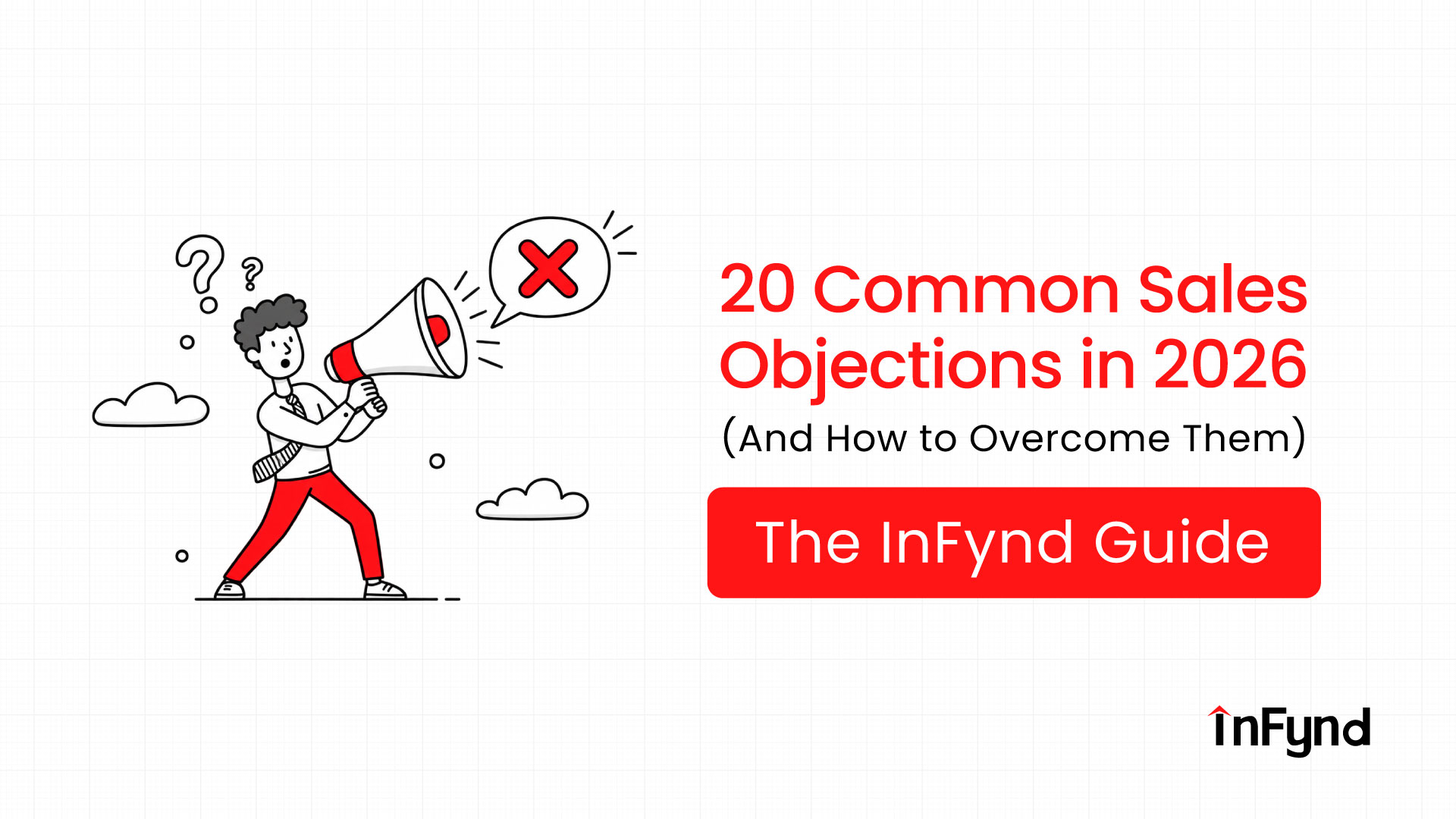
Every sales rep hears "no" before they hear "yes." Whether it's "we don't have budget," "we're happy with our current vendor," or "send me some information and I'll get back to you," sales objections are not rejections, they're requests for more clarity, trust, or timing. In 2026, with buyers more informed and more skeptical than ever, knowing how to handle objections in sales is what separates reps who hit quota from reps who chase it all quarter.
At InFynd, we work with over 10,000 sales and marketing teams worldwide, and one pattern shows up again and again: the reps who overcome objections fastest are the ones armed with verified B2B data before the call even starts. Objection handling isn't just a script problem, it's an information problem. Below, we break down the most common sales objections in 2026 and the response frameworks our customers use to turn hesitation into closed deals.
Why Sales Objections Happen More Often in 2026
Buyer behavior has shifted. Procurement cycles are longer, more stakeholders are involved in every purchase decision, and prospects are doing independent research long before a rep reaches out. This means cold outreach, B2B lead generation, and sales prospecting all need sharper targeting than they did even two years ago. When reps reach the wrong contact, at the wrong company, with outdated data, objections multiply, not because the product is wrong, but because the fit was never confirmed in the first place.
That's where accurate B2B contact data and firmographic insight come in. Reps who use enriched CRM data walk into conversations already knowing a prospect's company size, tech stack, and buying signals, which dramatically reduces objections like "this isn't relevant to us" or "we already have a solution."
The Most Common Sales Objections (Grouped by Category)
Budget objections: "We don't have the budget right now," "It's too expensive," or "We need to cut costs this quarter." The strongest responses reframe cost as ROI, using specific data points rather than generic value claims.
Authority objections: "I need to check with my manager" or "I'm not the decision-maker." Skilled reps use this moment to ask for an introduction rather than treating it as a dead end.
Need objections: "We don't need this" or "Not a priority right now." These are best countered by connecting the product to a business outcome the prospect already cares about, not by pushing features.
Trust objections: "I've never heard of your company" or "How do I know this works?" Case studies, verified reviews, and social proof close this gap quickly.
Timing objections: "Call me back next quarter" or "We're mid-way through another project." Reps who track intent signals know when a prospect's timing genuinely shifts, instead of guessing.
Competitor objections: "We're already using [competitor]." This is won or lost on specificity, knowing exactly what the competitor offers and where the gaps are.
Handling all six categories consistently requires more than good scripts. It requires knowing who you're talking to before you dial. This is a core reason InFynd customers rely on our B2B data solutions to prioritize leads that are genuinely sales-ready, cutting down on objections rooted in poor targeting.
How InFynd Helps Sales Teams Overcome Objections at Scale
Our platform is built on three principles that directly reduce objection frequency: accuracy, relevance, and timing.
1. Accurate B2B data: With 240M+ verified contacts and 12M+ companies, InFynd helps reps reach the right decision-maker the first time, avoiding wasted calls that trigger authority objections.
2. Enrichment and CRM hygiene: Outdated CRM records are one of the biggest hidden causes of objections. Our CRM data health check and data enrichment tools keep every record fresh, so reps never pitch based on stale information.
3. Intent and buying signals: Knowing when a company is actively evaluating solutions helps reps time outreach so timing objections rarely come up at all.
Sales objections will never disappear completely, they're part of every genuine buying conversation. But the volume and difficulty of objections drop sharply when reps start with trustworthy data and end with a clear, outcome-focused pitch. If you're rebuilding your outbound motion for 2026, start with the data layer first. Explore more strategies in our B2B sales blog, or book a demo to see how InFynd's verified data platform helps your team spend less time getting rejected and more time closing.
FAQs
1. What is the most common sales objection in 2026?
Budget-related objections remain the most common, followed closely by "we're already using a competitor" and timing-based pushback. Most of these can be reduced significantly with better lead targeting and verified B2B data before outreach even begins.
2. How can B2B data reduce sales objections?
Accurate, enriched B2B data ensures reps are speaking to the right decision-maker at companies that genuinely fit the product's ideal customer profile. This cuts down on objections caused by poor targeting, such as "this isn't relevant to us" or "I'm not the right person."
3. What's the difference between objection handling and objection prevention?
Objection handling is what a rep says in the moment to address hesitation. Objection prevention happens earlier, using verified data, intent signals, and CRM enrichment to reach the right prospect at the right time, so fewer objections come up in the first place.