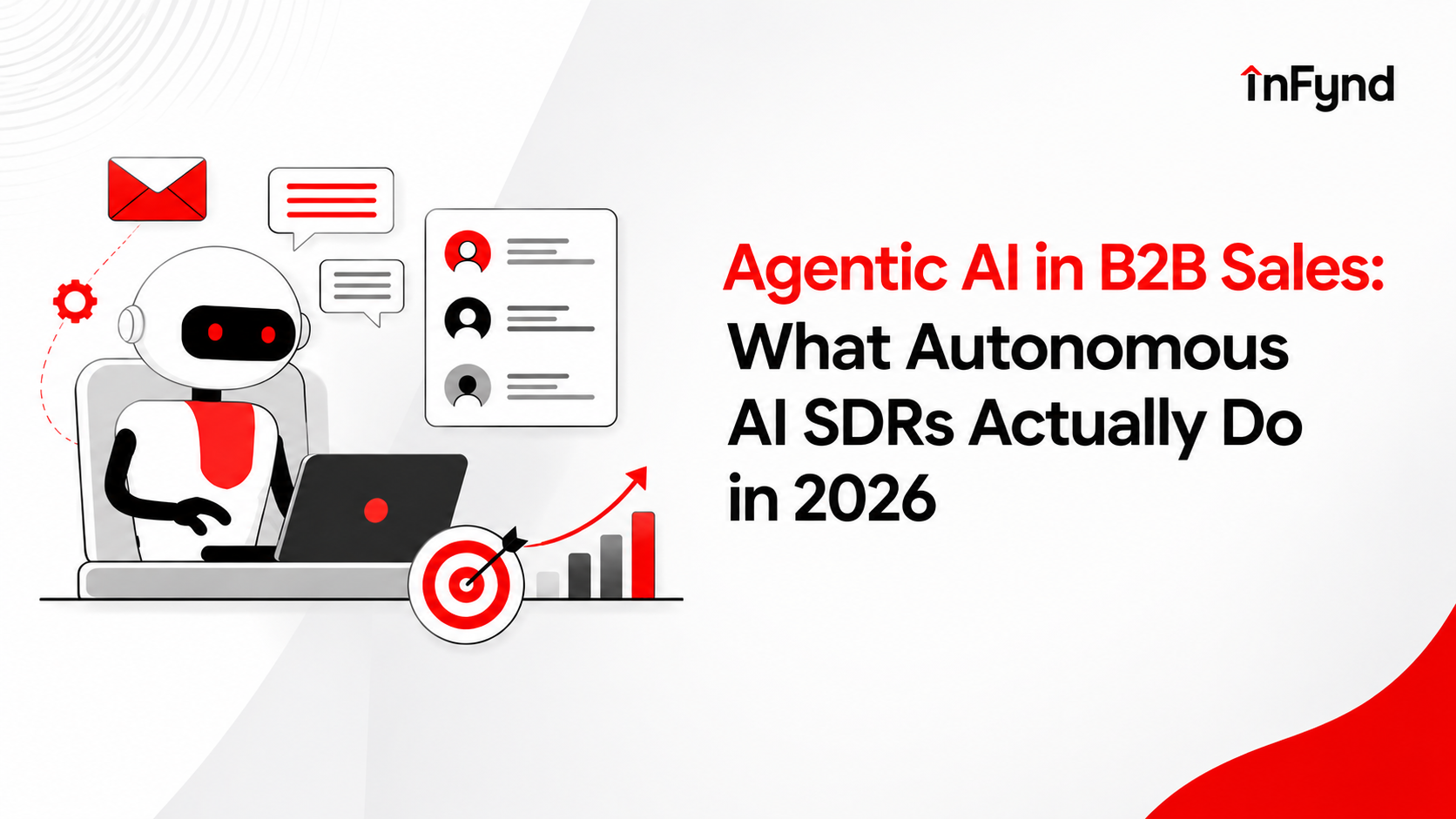
For the last two years, "AI in sales" mostly meant a co-pilot, something that drafted your email or summarized your call. In 2026, that's changed. At InFynd we work with revenue teams navigating exactly this shift, so this guide reflects what we're seeing across the market, not just theory. A new category of tools, often called agentic AI or autonomous AI SDRs, doesn't just assist a rep. It runs entire pieces of the outbound motion on its own, researching accounts, writing and sending sequences, qualifying replies, and booking meetings without a human touching most of the workflow.
The term is everywhere right now, and like most fast-moving categories, it's surrounded by both genuine capability and a fair amount of hype. This guide breaks down what agentic AI actually does today, where it still falls short, and how revenue teams should be thinking about it heading into next year.
• Agentic AI enables AI SDRs to independently research accounts, personalize outreach, qualify leads, and schedule meetings.
• Unlike traditional sales automation, agentic AI continuously makes decisions based on live signals and learns from outcomes.
• Human sales professionals remain essential for negotiation, relationship building, and complex buying decisions.
• Success with autonomous AI depends entirely on accurate, verified customer and company data.
• Start narrow, automate one workflow well before expanding AI-driven outbound across your GTM stack.
What "Agentic" Actually Means (And Why It's Different From Automation)
Traditional sales automation follows fixed rules: if a lead fills a form, send email A, then email B three days later. It doesn't think, it executes a sequence.
Agentic AI is different because it can make decisions inside a workflow, not just follow one. Given a goal ("book meetings with VP-level buyers at mid-market fintechs"), an AI agent can pull and enrich its own account list from live data signals, decide which accounts are worth prioritizing based on real-time intent, draft outreach personalized to each account's specific context, read a reply and decide the next action follow up, escalate to a human, or disqualify and adjust its own approach based on what's working.
That decision-making loop sense, decide, act, learn is what separates an agent from a sequence tool. It's also why the shift matters: it moves AI from "helping a rep do their job faster" to "doing a defined chunk of the job."
Traditional Automation vs Agentic AI
• Rule-based workflows → Goal-driven decision making
• Fixed email sequences → Dynamic outreach strategies
• Manual list updates → Continuously enriched data
• Limited personalization → Context-aware personalization
• Executes predefined actions → Chooses the next best action
• Requires frequent human management → Operates with minimal supervision
The core difference, in one line: traditional automation follows instructions, agentic AI determines what should happen next.
Why This Is Happening Now
Three forces are converging at once.
Buyers have already left the funnel top: Recent buyer research puts rep involvement at well under a fifth of the total B2B buying journey, most evaluation now happens before anyone talks to sales. That makes timing and relevance more important than ever: AI agents can continuously monitor thousands of accounts for buying signals and reach out exactly when interest peaks, at a scale no human team can manage manually.
AI adoption is moving beyond productivity tools: Most organizations already use AI for note-taking, email drafting, or CRM summaries but a much smaller share of individual reps actually use the AI features built into their tools day to day. Agentic AI is the next stage past that gap. Instead of reminding a rep what to do, the AI just does it, adoption isn't optional when the agent runs the workflow itself.
Signal-based selling needs constant monitoring: Modern outbound depends on recognizing triggers like funding announcements, executive hires, technology changes, hiring surges, and product launches. Watching for these manually across thousands of companies is nearly impossible. This is exactly the always-on task agentic systems are built for.
What Can Autonomous AI SDRs Actually Do?
Today's agentic sales platforms genuinely excel at repetitive, data-driven work:
• Account research at scale: Gathering firmographic, technographic, and intent data across thousands of companies instead of the dozens a human could realistically cover in a day.
• Personalized outbound outreach: Generating emails from live signals (a recent funding round, a new executive hire, a hiring surge) rather than a generic template, which produces meaningfully more relevant first-touch messaging.
• Intelligent lead qualification: Interpreting replies, detecting buying intent, spotting objections, and routing only genuinely warm conversations to a rep, cutting the time spent sifting low-value responses.
• Consistent follow-up: Human reps naturally get busy and let smaller accounts slip. An agent doesn't. It follows every prospect on strategy, every time, adapting messaging based on prior interactions.
Where Human Sales Teams Still Win
It's worth being honest about the limits here, because overstating what these systems do is exactly how trust in a category gets damaged.
Complex negotiations: Involving multiple stakeholders, competing priorities, and real emotional dynamics still play to human strengths, experienced reps continue to outperform AI once a deal gets into genuine back-and-forth.
Long-term relationship building: Depends on trust developed through real conversation. Healthcare, financial services, government, and enterprise technology sales still lean heavily on human relationships, not just well-timed messages.
Ambiguity: Pricing objections, procurement delays, internal politics, the objection nobody scripted for, requires judgment, creativity, and empathy that AI doesn't consistently replicate today.
The realistic model for 2026 isn't "AI replaces SDRs." It's this: AI manages repetitive execution, humans manage strategic conversations with AI running the top of the funnel and handing off a much smaller number of well-qualified conversations to reps who spend their time only where judgment actually matters.
Why Data Quality Determines AI Success
One of the biggest misconceptions about agentic AI is that better algorithms alone produce better results. In reality, an agentic system is only as good as the data feeding its decisions.
If an autonomous system is operating on outdated contacts, incorrect job titles, inactive companies, or inaccurate intent signals, it doesn't fail quietly, it scales the mistake, instantly and repeatedly. Poor data plus autonomous execution is a fast way to damage domain reputation and burn through a market before you've properly entered it.
Better AI begins with better data. Reliable verification, enrichment, and continuous data updates aren't a nice-to-have around an agentic rollout — they're the foundation it stands on.
Best Practices for Implementing Agentic AI
If you're evaluating where agentic AI fits into your outbound motion, a few practical steps hold up regardless of which vendor you choose:
1. Audit your data before you automate anything: Clean, verified customer and company information always comes before automation automating on top of decayed data multiplies the damage rather than fixing it.
2. Start with narrow, measurable workflows: Account research, lead enrichment, first-touch outreach, and lead qualification are the safest, most repeatable places to hand decisions to an agent first.
3. Keep human oversight before meetings, proposals, or negotiations: at least while your team builds confidence in how the agent is qualifying opportunities.
4. Measure quality, not activity: Positive reply rate, qualified meeting rate, meeting attendance, and pipeline influenced matter far more than sequences sent.
Frequently Asked Questions
What is an AI SDR?
An AI SDR (Artificial Intelligence Sales Development Representative) is software that automates outbound sales tasks such as prospect research, personalized outreach, lead qualification, and meeting scheduling.
What is the difference between agentic AI and sales automation?
Traditional sales automation follows predefined rules. Agentic AI independently evaluates information, makes decisions, and adapts its actions based on outcomes.
Can AI SDRs replace human SDRs?
Not entirely. AI excels at repetitive, high-volume tasks, but human reps remain essential for negotiation, relationship building, and complex enterprise sales.
What industries benefit most from agentic AI?
Industries with large outbound sales motions, SaaS, technology, cybersecurity, healthcare staffing, and financial services tend to benefit most from autonomous prospecting and qualification.
Is data quality important for agentic AI?
Yes, critically. Accurate contact data, company information, and buying signals directly determine the quality of AI-generated outreach and lead qualification.
Where InFynd Fits
Autonomous AI is only as effective as the data behind its decisions. InFynd's Global Data Intelligence platform provides verified B2B and healthcare contact data, enriched company intelligence, and real-time buying signals that help revenue teams build a reliable foundation for AI-powered outbound strategies.
Complementing this, 27x.ai, InFynd's AI agent platform empowers sales and marketing teams with autonomous AI agents that streamline prospecting, outreach, qualification, and engagement, enabling smarter go-to-market execution powered by verified, high-quality data.
For organizations exploring agentic AI, building a trusted data foundation today is one of the most practical steps toward successful autonomous sales execution tomorrow. Explore InFynd's Global Data Intelligence platform or join the 27x.ai waitlist to be among the first to try it when it launches.