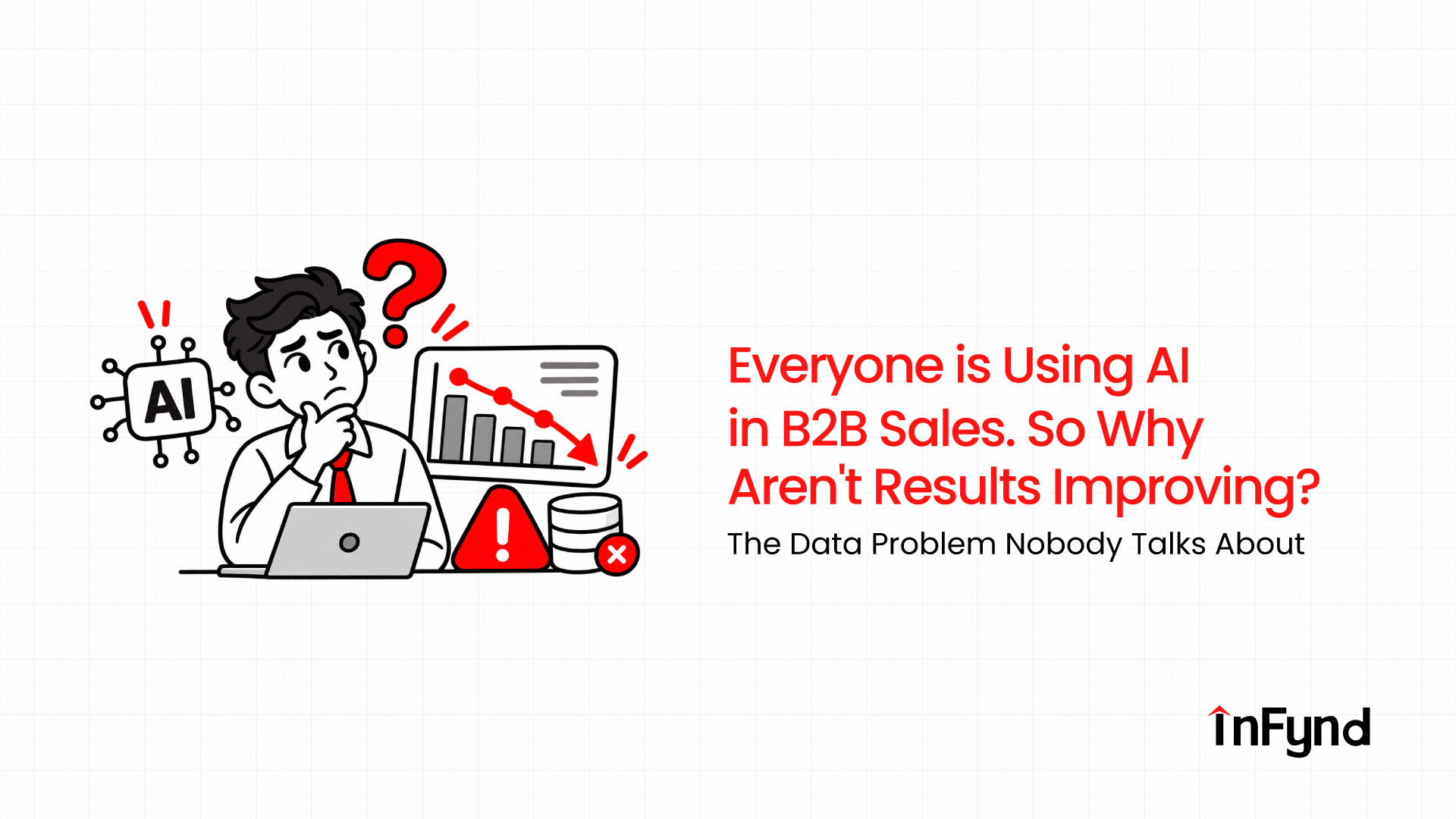
AI tools for sales are everywhere. Email writers, lead scorers, research assistants and AI agents for sales and marketing now sit in almost every team's stack. Yet when leaders look at pipeline, win rates and rep productivity, the gains often fall short of the promise. The tools aren't the problem. The data feeding them is.
The AI Adoption Gap
Industry surveys through 2026 keep showing the same pattern: adoption of AI is high, but reported performance improvement is much lower. Teams bought tools faster than they fixed the foundations underneath them.
AI doesn't create information. It processes what you give it, faster and at greater scale. Feed it accurate, complete data and it multiplies good decisions. Feed it stale or incomplete data and it multiplies mistakes just as quickly.
What Bad Data Does to AI Sales Tools
Here is how poor data quietly breaks the most popular AI use cases:
• AI email writing: The tool personalizes a message around a job title the contact left a year ago, so the email reads as careless.
• AI lead scoring: Scores built on missing industry or company size fields rank the wrong accounts first.
• AI research assistants: Summaries rely on outdated company information, so reps walk into calls uninformed.
• AI agents running outbound sales: An agent that emails thousands of invalid addresses wrecks email deliverability within days, and that damage affects every campaign afterwards.
• AI forecasting: Duplicate and wrongly staged records inflate the pipeline, so forecasts miss.
In each case the AI worked exactly as designed. The input let it down.
The 5 Data Problems Holding AI Back
1. Stale contacts:
People change jobs often. Records that were right last year are wrong today, and AI tools can't tell.
2. Duplicate and incomplete records:
Split histories and blank fields leave AI with a partial picture of every account.
3. Missing buying context:
Knowing who someone is doesn't tell you whether they're ready to buy. Without intent data, AI can personalise a message but can't time it.
4. Disconnected systems:
When your CRM, marketing platform and sales tools hold different versions of the truth, every AI tool inherits the confusion.
5. Unclear compliance status:
AI that contacts people without a clear lawful basis or consent record creates risk at machine speed.
A 5 Question Data Readiness Test
Before adding another AI tool, answer these honestly:
1. Do you know your email bounce rate by data source?
2. Have you deduplicated your CRM in the last six months?
3. Are job titles, phone numbers, and industry fields complete for your target accounts?
4. Do you have any signal showing which accounts are in the market right now?
5. Can you show consent and suppression status for every contact?
If you answered no to two or more, fix the data before you scale the AI.
How to Fix the Foundation
Audit your CRM first:
Find duplicates, invalid emails and consent gaps before AI touches them. A CRM Data Health Check gives you that baseline.
Enrich what you already own:
Data enrichment refreshes job titles, contact details and firmographic fields, so AI works from current records.
Add timing with intent data:
Intent and signals data tells AI which accounts to prioritise now, turning sales intelligence from a static list into a live view of demand.
Source verified B2B data:
New leads should arrive accurate. Verified B2B data keeps the pipeline clean from the start.
Feed AI from one source:
Fewer, better connected data sources mean AI sees the same facts your reps do.
Conclusion
Before you sign for another AI tool, ask one question: what data will it run on?
That question is where InFynd fits. InFynd is built to be the data layer that makes AI sales intelligence work. Its B2B data platform brings together verified contacts across 240M+ profiles and 12M+ companies at 95%+ accuracy, with enrichment to keep records fresh, intent signals to show who is ready to buy, and a CRM Data Health Check to clean what you already hold. Everything is GDPR and CCPA compliant, so your AI agents and your reps act on data you can stand behind. The result is simple: AI that personalises correctly, scores accurately and reaches real inboxes, instead of producing faster mistakes.
Explore InFynd's B2B Data Platform
FAQ
1. Why isn't AI improving my B2B sales results?
In most cases the cause is data quality. AI built on stale, duplicate or incomplete records produces poor personalisation, wrong lead scores and wasted outreach.
2. What data do AI sales tools need to work well?
Verified contact details, complete firmographic fields, current job titles, buying signals and clear consent records, all held consistently across your CRM and sales tools.
3. Can AI agents damage email deliverability?
Yes. Agents that send to invalid or outdated addresses raise bounce rates, which harms sender reputation and reduces inbox placement for every later campaign.
4. How often should I clean my CRM data for AI use?
Review it quarterly at minimum, and run a full audit and enrichment before connecting any new AI tool to your records.