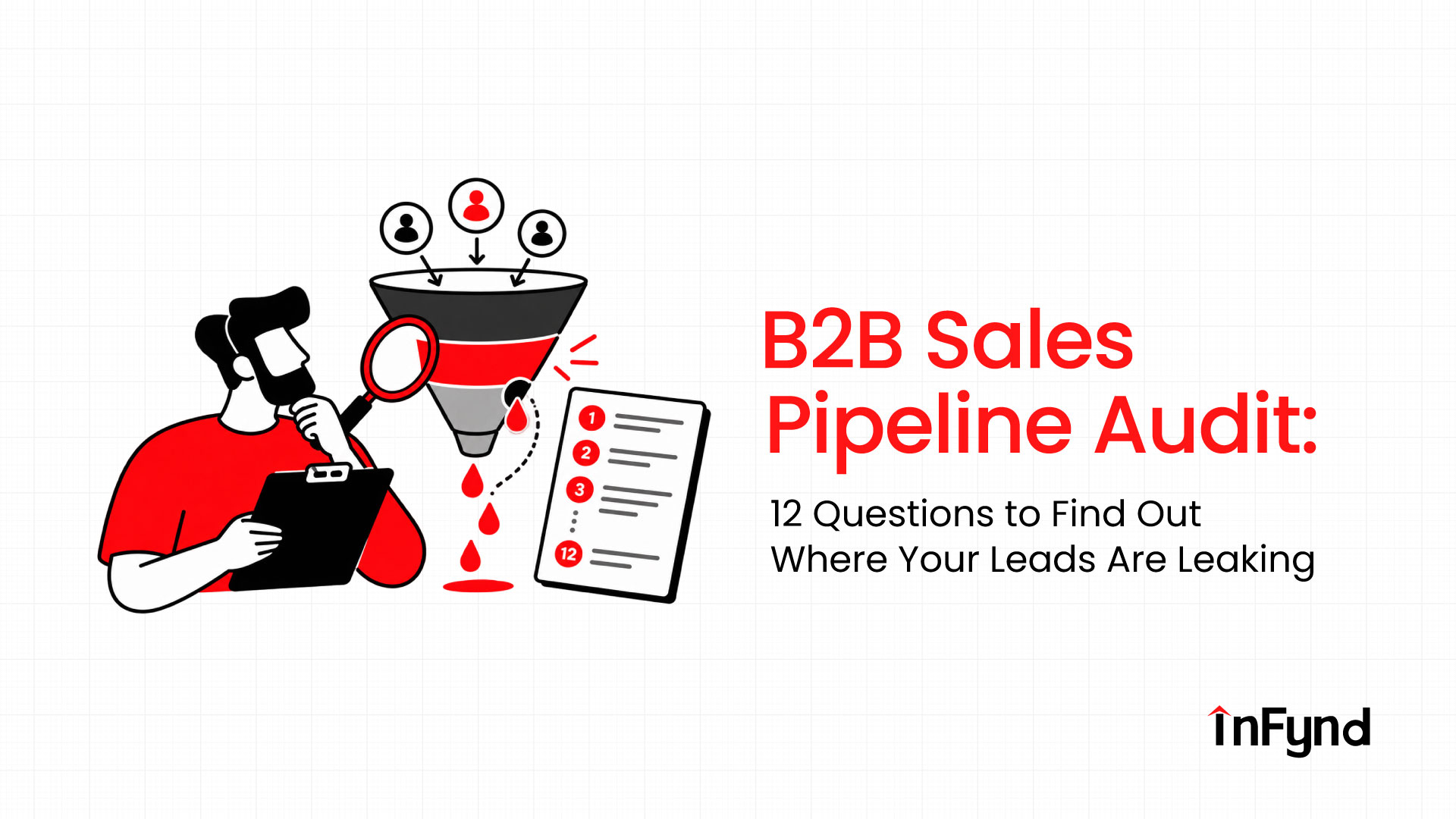
Most pipelines don't fail with a bang. They leak. A bounced email here, a duplicate lead there, a hot account nobody follows up. Each leak is small, so they go unnoticed until the quarter misses target. These 12 questions help you find them.
How to Use This Audit
Pull a sample of 100 recent leads from your CRM and answer with evidence, not gut feel. Score each question 0 (no), 1 (partly) or 2 (yes), then add up your total.
Section 1: Lead Generation and Demand Generation
1. Do you know which sources produce qualified pipeline?
Many teams count form fills from demand generation campaigns but never trace them to closed revenue. If leads look healthy at the top and vanish by stage two, your sourcing needs work.
2. Does your lead generation data match your ICP?
Check industry, company size and job role across your sample. If a large share sits outside your ideal customer profile, effort is leaking before outreach even starts. This matters even more for ABM, where target account lists must be complete and accurate.
3. Are you reaching accounts that are actually in market?
Without buying signals, outreach lands too early or too late. InFynd's intent and signals data shows which accounts are researching now, and market intelligence helps you judge where demand is growing.
Section 2: Outbound Sales and Email Deliverability
4. What is your email bounce rate?
Persistent bounces damage sender reputation and shrink the reach of future campaigns. Track bounces by source to find the problem data.
5. Are your emails reaching the inbox?
Email deliverability depends on domain reputation, and bad contact data is one of its biggest enemies. If open rates have fallen with no change in messaging, check spam placement.
6. How often do reps hit stale contacts?
Count wrong numbers, bounced emails and "no longer works here" replies in your outbound sales activity. High rates mean your contact data is decaying faster than you refresh it.
Section 3: CRM Integration and Data Quality
7. Does data flow cleanly between your tools?
Gaps in CRM integration, such as failed syncs or mismatched fields, leave records out of date. A Salesforce integration with poor field mapping can quietly corrupt reporting for months. Data integration and APIs help keep systems aligned.
8. How many duplicate records do you have?
Duplicates cause double outreach, split activity history and unreliable reports. Even a small duplicate rate distorts account level views.
9. How complete are your records?
Missing job titles, phone numbers or industry fields stop reps from personalising and stop segmentation from working. Data enrichment fills these gaps, and sales intelligence tools only deliver value when the underlying records are complete.
Section 4: Revenue Operations and Compliance
10. Is lead handoff clear?
Revenue operations teams should define exactly when a lead moves from marketing to sales, and who owns it. Unassigned or unworked leads are among the most common and most costly leaks.
11. Is your lead scoring built on clean data?
Scoring rules applied to wrong or missing data rank the wrong leads first. Validate scoring against clean records before trusting it.
12. Could you pass a consent audit today?
Check opt in status, consent records and suppression flags. A proper GDPR audit trail protects you from compliance risk and keeps unsubscribed contacts out of campaigns.
Scoring Your Audit
• 20 to 24: Your pipeline is healthy. Keep monitoring quarterly.
• 12 to 19: You have real leaks. Prioritise the section where you scored lowest.
• Below 12: The problem is your data foundation. Fix it before spending more on lead generation.
Sections 2, 3 and 4 share a root cause: data quality. Fixing it usually closes several leaks at once.
Conclusion
An audit tells you where the pipeline leaks. Some leaks, like unclear handoffs, need a process change. But most of the others start in one place: the data inside your CRM. Bounces, duplicates, stale contacts, wrongly scored leads and consent gaps all begin there, and even well sourced leads decay once they enter a dirty database.
That is what InFynd's CRM Data Health Check is built for. It works in three steps: a secure audit of your CRM, a cleanse and enrichment pass, then a clean import back with ongoing monitoring. It finds and merges duplicates without losing history, validates emails and phone numbers, completes missing fields, and checks consent and suppression records for GDPR. It supports Salesforce, HubSpot, Zoho, Microsoft Dynamics and Pipedrive, and AI spots decaying records and consent gaps that manual reviews miss. With regular hygiene cycles afterwards, your CRM stays clean instead of decaying again, and InFynd's enrichment and intent data keep new leads accurate from the moment they arrive. Trusted by 1,000+ companies, InFynd turns your audit results into a database your team can rely on.
Get Your CRM Data Health Check →
FAQ
1. What is a B2B sales pipeline audit?
It is a structured review of every stage of your pipeline, from lead source to closed deal, to find where leads drop out and why.
2. How often should I audit my sales pipeline?
Quarterly works for most teams, with an extra audit before major campaigns or after a CRM migration.
3. What causes most pipeline leaks?
Poor data quality is the most common root cause, showing up as bounced emails, duplicate records, stale contacts and weak lead scoring.
4. How does a CRM data health check help?
It audits your CRM for duplicates, invalid contacts and consent gaps, then cleanses and enriches the records so outreach and reporting work from accurate data.