If your sales team keeps chasing leads that never close, the problem usually isn't effort. It's targeting. Firmographic data is the foundation that fixes that. It tells you who a company is before you spend a single hour trying to sell to them.
What is Firmographic Data?
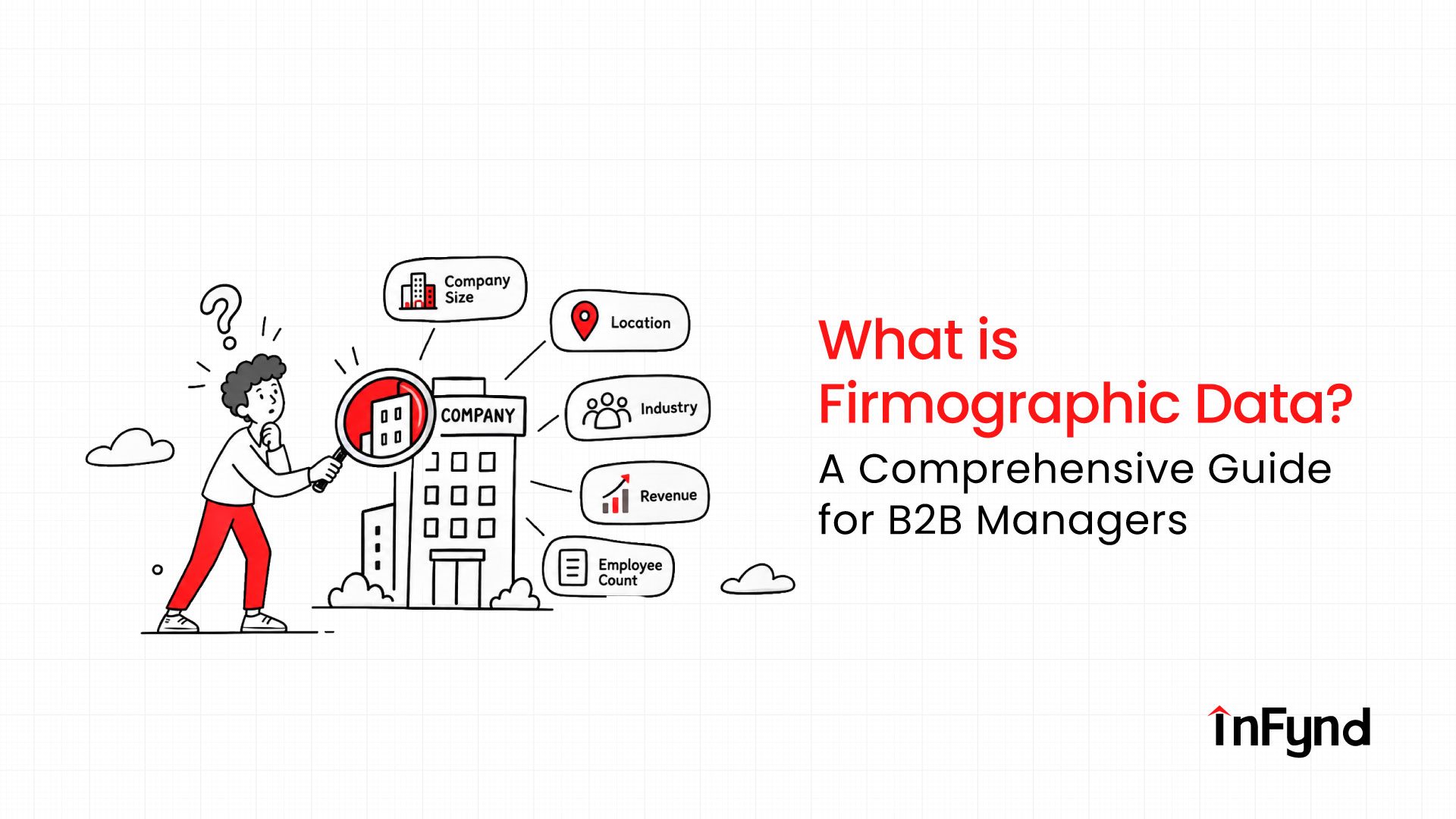
Firmographic data is the set of characteristics that describe a business, much like demographics describe an individual. Instead of age or income, firmographics cover company level attributes: industry, size, revenue, location, and ownership structure.
In short, firmographic data answers one question: "Is this company worth pursuing?"
Key Types of Firmographic Data
• Industry: Sector classification (often by SIC or NAICS code), used to match companies to your ideal customer profile (ICP).
• Company size: Employee count, typically grouped as small (under 200), mid market (200 to 2,000), or enterprise (2,000+).
• Revenue: Annual revenue, a strong signal of budget capacity.
• Location: Headquarters and operating regions, critical for territory planning and compliance.
• Ownership & structure: Public, private, subsidiary, or franchise status.
• Growth stage: Funding round or maturity level, especially relevant for startups and scale ups.
Why Firmographic Data Matters for B2B Teams
1. Sharper ICP definition: Firmographics let you define exactly which companies fit your product, by size, industry, and revenue, instead of guessing.
2. Better segmentation: Grouping accounts by firmographic traits helps you tailor messaging instead of sending the same pitch to every prospect.
3. Smarter account based marketing (ABM): ABM campaigns depend on knowing which accounts are worth the investment. Firmographic data is the filter that makes ABM efficient rather than expensive guesswork.
4. Cleaner sales forecasting: When your pipeline is built on companies that genuinely match your ICP, forecasting becomes far more reliable.
How to Use Firmographic Data in B2B Sales & Marketing
1. Build your ICP using 3 to 4 core firmographic filters (industry, size, revenue, location). InFynd's B2B Data Solutions page shows how these filters work in practice.
2. Segment your existing CRM to identify accounts that already match and those that don't. This is where a CRM Data Health Check helps, by flagging gaps before you build campaigns on incomplete records.
3. Prioritize outbound lists so reps spend time on accounts with real budget and fit.
4. Layer in technographic and intent data to know not just who to target, but when and how. InFynd's Intent & Signals data adds this timing layer on top of firmographics.
Firmographic vs. Technographic Data
Firmographic data tells you what a company is: industry, size, revenue. Technographic data tells you what technology it uses: CRM, cloud provider, marketing stack. They answer different questions, and the strongest targeting strategies use both together. Firmographics find the right companies, technographics show how to approach them.
Best Practices for Using Firmographic Data
• Refresh your data regularly, since headcount and revenue change often.
• Combine firmographic filters with intent signals to prioritize in market accounts.
• Avoid over filtering; too many criteria can shrink your addressable market.
• Validate data accuracy before large campaign pushes.
• For sector-specific targeting, InFynd's Industry Data Solutions apply firmographic depth across 195+ industries.
Choosing the Right B2B Data Provider for Firmographic Accuracy
Firmographic data is only as useful as its accuracy. Stale or poorly sourced records lead to wasted outreach, bounced emails, and misjudged ICPs. When evaluating B2B data providers, look for:
• Verification frequency: how often records are validated, not just collected.
• Coverage depth: global company and contact coverage across your target industries.
• Compliance: GDPR, UK GDPR, and CCPA adherence, especially for UK and EU outreach.
• Integration : native CRM and marketing automation compatibility, so enrichment fits your existing workflow.
The right provider turns firmographic data from a static list into a live, reliable targeting asset.
Conclusion
Firmographic data isn't just a targeting checkbox. It's the difference between a pipeline full of guesses and one built on qualified, sellable accounts. Getting it right starts with a B2B data provider you can actually trust to keep that data accurate and current.
This is where InFynd fits in. InFynd's B2B platform gives you firmographic data across 240M+ verified contacts and 12M+ companies globally, maintained at 95%+ accuracy through continuous validation. Filter by industry, size, revenue, and location, then enrich your CRM or export prospect lists, fully GDPR and CCPA compliant.
FAQ
1. What is firmographic data used for?
It's used to identify and qualify B2B target accounts based on company characteristics like industry, size, revenue, and location, forming the basis of an ICP.
2. How is firmographic data different from demographic data?
Demographic data describes individual people (age, job title, income). Firmographic data describes the companies those people work for (industry, size, revenue).
3. How often should firmographic data be updated?
Ideally every 1 to 3 months, since attributes like revenue, headcount, and funding stage change frequently and outdated data leads to wasted outreach.
4. Can firmographic data improve conversion rates?
Yes. Targeting accounts that genuinely fit your ICP reduces wasted effort and typically results in higher response and conversion rates than broad, unfiltered outreach.
5. Where can I get accurate firmographic data for B2B prospecting?
Reputable B2B data providers like InFynd offer verified firmographic data across 240M+ contacts and 12M+ companies, with continuous accuracy checks and CRM integration.
6. How do I choose between different B2B data providers?
Compare them on verification frequency, coverage depth, compliance (GDPR/CCPA), and how easily their data integrates with your CRM. Accuracy and freshness matter more than raw contact volume.